

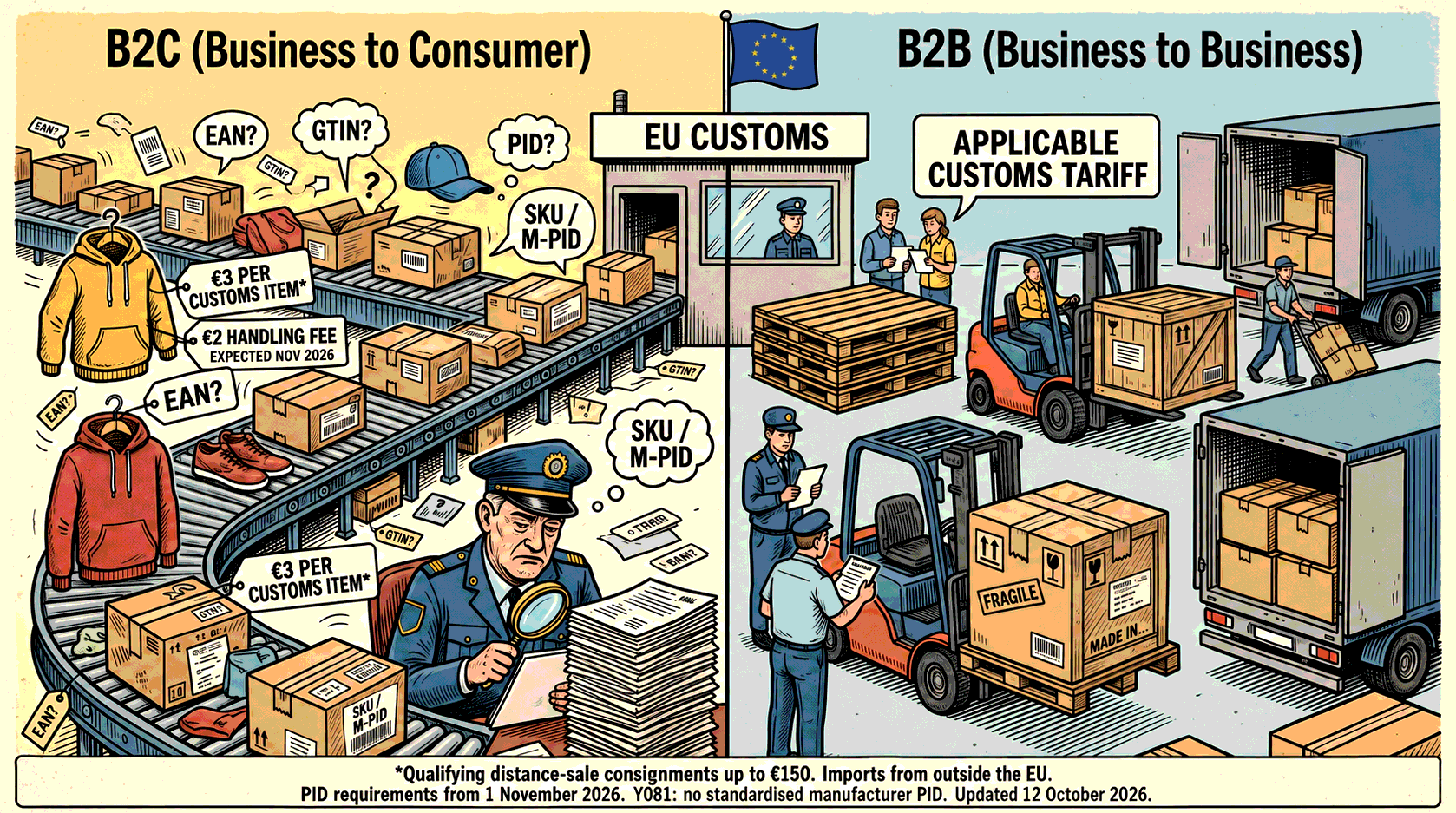
Updated 12 October 2026
Shipping goods from outside the European Union into the EU now requires a closer look at both the transaction and the product data. The €150 customs duty relief ended on 1 July 2026. Further requirements are due in November, so businesses should distinguish what already applies from what they need to prepare for. [1–4]
These changes concern imports into the EU. They do not describe ordinary movements of goods already in free circulation between EU member states.
What has changed — and what comes next
B2C: calculate the cost by customs declaration line
For qualifying distance sales of imported goods in consignments with an intrinsic value not exceeding €150, the temporary duty is €3 per customs item. It is scheduled to apply until 1 July 2028. The applicable regime and any preferential tariff treatment still need to be checked. [1, 2]
A customs item is not necessarily one physical product or one invoice line. Goods can share a declaration line when the required classification, description and, where relevant, origin are the same. The declaration dataset affects the level of tariff detail required. [2, 4]
Example: a €30 order with three declaration lines
Assume a hoodie, a cap and socks require three separate customs declaration lines and the €3 regime applies. The duty is 3 × €3 = €9. Once the expected handling fee takes effect, a further 3 × €2 = €6 would bring these two charges to €15. This is an illustration, not a complete landed-cost quotation: VAT, transport and any carrier or broker charges must be considered separately. [1, 2, 5]
Product identifiers: prepare the data before November
From 1 November 2026, affected e-commerce import declarations must include product identifiers. They have been voluntary since July. The Commission’s October guidance describes the requirement as covering distance-sale consignments not exceeding €150; it also notes that a legislative clarification of this value limit is being prepared. [2–4]
Y081 indicates that no standardised manufacturer product identifier exists for the declared product. It does not replace the other mandatory identifiers, and the absence of a printed barcode alone is not the test. [3, 4]
Ask suppliers for the required identifiers now and make sure they reach the party filing the declaration. Review how your catalogue records product variants and how those records feed into shipping documents. Treat this as a data handover process, rather than a last-minute invoice correction.
B2B: the transaction matters more than the label
Genuine B2B imports generally fall outside the distance-sale rules discussed here. However, a company name on the delivery address is not sufficient evidence: some supplies to businesses or legal entities can still qualify as distance sales, depending on their VAT status. [2]
For ordinary B2B imports, do not assume that customs duty is always a percentage of the invoice value. Confirm the applicable tariff treatment for the goods, origin and procedure. A shipment of samples also needs its own assessment; “sample” is not an automatic exemption.
The handling fee is a separate charge
As of this article’s update date, the €2 Union handling fee is expected from 1 November 2026. It is separate from customs duty and applies per declaration line to qualifying distance-sale imports, including consignments above €150. The Commission’s guidance identifies the delegated act setting the amount as still under scrutiny. Businesses should budget for it and confirm the final commencement before quoting November shipments. [2, 5]
Before your next shipment
- Confirm the transaction type. Establish the actual buyer and relevant VAT status; do not rely on a B2B/B2C label alone.
- Check the goods and procedure. Agree accurate descriptions, classification, value and origin with the declarant.
- Prepare product data. Collect the required seller and manufacturer identifiers for affected November shipments.
- Build a complete cost estimate. Separate duty, the expected handling fee, VAT, transport and clearance charges. Agree who pays each charge.
- Check the declaration handover. Distinct consumer consignments must be treated separately; avoid losing order-level information when shipments are consolidated. [2]
- Resolve missing information before dispatch. Confirm the carrier’s or broker’s current data requirements and how corrections will be handled.
Need to prepare your logistics systems for EU customs data requirements? Contact Walrus to discuss product-data integration, declaration workflows and shipping automation.
Official sources
Checked on 12 October 2026. Read the linked guidance together with the applicable legislation; the expected handling-fee commencement should be checked again when planning November shipments.
